
"OEDIPUS:" The Candidate Self-Smeared

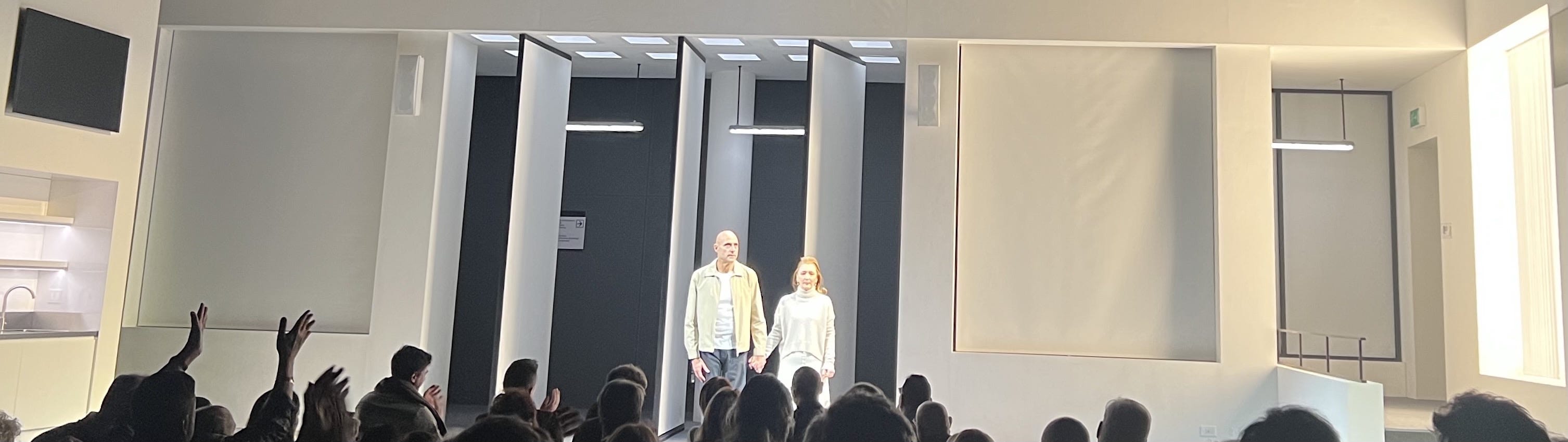
Oedipus is a tough one. That’s what I found myself thinking the further I sank into the critically lauded, British-updated Oedipus now bloodily unspooling at Studio 54.
I mean, it’s all pre-ordained. That’s what Oedipus is. Tough to wring drama from the predictable. Though, obviously, not impossible. Sophocles did.
Oedipus in New York is only somewhat Sophocles and mostly Robert Icke, the much-praised British doctorer of the classics, theatrically, who wrote and directed this very slick updating. I appreciated his craftsmanship. I just wanted to be less aware of it.
Mr. Icke situates Oedipus in a luxe bunker-like suite on an election night that resembles Obama’s first ascendancy to the Presidency, though it seems clear we are not in America, and the actor playing Oedipus, Mark Strong, is white. Icke’s Oedipus is most Obama-like in that he represents “change” — as Oedipus and everyone around him reiterate. His election, we are repeatedly told, will be epochal.
Once these equivalencies are established — Sophocles’ Oedipus the King is now Icke’s Oedipus the Candidate and we are not in ancient Greece anymore — most of the drama follows the touchstones of Sophocles’ Oedipus Rex as contemporized by playwright Icke and director Icke. Teiresias, the soothsayer who arrives early and predicts everything? That would be the stoner-ish kid from some futurist cult who eludes security to give Oedipus an earful. Laius, King of Thebes? Still Oedipus’s murdered predecessor (and secret father) but now (we learn), run over by Oedipus in a reckless, long-ago car smash. As for the self-blinding of Oedipus? Less clear. I actually thought for a moment at the end that Mark Strong was just fetishistically kissing the dead Jocasta’s stiletto shoe heel. Boy was I wrong. But, in my defense, he never did truly jab it.
Icke fills Oedipus with video screens and a non-stop reel of faux news-night election coverage intercut with faux interview newsclips of Oedipus. Any live theatrical creation that opens with a video, as Oedipus does, has already lost me (though that’s, ultimately, my problem). End-to-end, there was a lot happening beyond the screens onstage that I applauded about Icke’s Oedipus; the tempo is taut; the inside baseball of a big-time election campaign is vivid; the depiction of Oedipus family life stripped of its public facade, kids and all, is nicely tough and tender.
The acting is also top drawer, led by Mr. Strong— a performer of distinction in the UK (Best Actor Olivier Award as Eddie Carbone for Arthur Miller’s A View from the Bridge, plus a Tony nomination, when he brought that revival here in 2016, plus multiple Olivier nominations, including one for this very production). As Oedipus, he conveys both intelligence and a buff yet compassionate virility that is actually a rare combination onstage these days. Mr. Strong offered up a compelling, satisfyingly self-regarding yet not quite arrogant Oedipus; an Oedipus who cares. I bought it.
As for Lesley Manville as Jocasta, well, she’s Lesley Manville — possessor of two Oliviers, including one for this same performance in London, among so many other attainments; Academy Award nominee (The Phantom Thread), two seasons as Princess Margaret in The Crown. She plays the hell out of Jocasta, a still sensually attentive wife to her husband Oedipus, cooly efficient yet maternal in ways that will prove devastating in the end.
So why didn’t I care more? I spent some time trying to figure this out. Sophocles’ Oedipus Rex is a mythological ritual of predictability. The soothsayer tells all. We then watch his foretellings unfold as if in a spiral of inevitability that is fate.
Fate makes for good drama. But fate is hard to conjure. In the context of Greek mythology, it is almost tactile, practically a character. In the context of Oedipus in New York, it is mostly words. And equivalencies. Nothing about the play’s arc or ending felt fated.
Sitting there in the dark, I hit upon an equivalency of my own, down the conspiracy rabbit hole. Any Oedipus running for high office on a platform of “change” today would face an opposing party determined to smear him with lies. Icke touches on this at the outset by having Oedipus promise to release his birth certificate, if elected. His handlers are shaken by this announcement but the whole birth certificate business felt like a dated MacGuffin, to me, however obviously Obama-esque.
But… what if Oedipus was flat-out accused by online trolls of the most appalling lies they could make up: That he’d secretly murdered his father and slept with his mother! Social media could claim there were “files” with proof — the files still unreleased. An outraged Oedipus (and his “team”) would deny these outrageous accusations, sincerely. But the accusations would not go away. And then, on election night, with the clock ticking down, and victory in Oedipus’s grasp, he and Jocasta would discover, to their horror… well, what they have been discovering now for centuries on end. That it was all true.